Why is your dog itching? The food question vets don't ask.
If the scratching has been going on for more than two weeks and you've ruled out fleas, the food is the place to look first.
· 10 min read
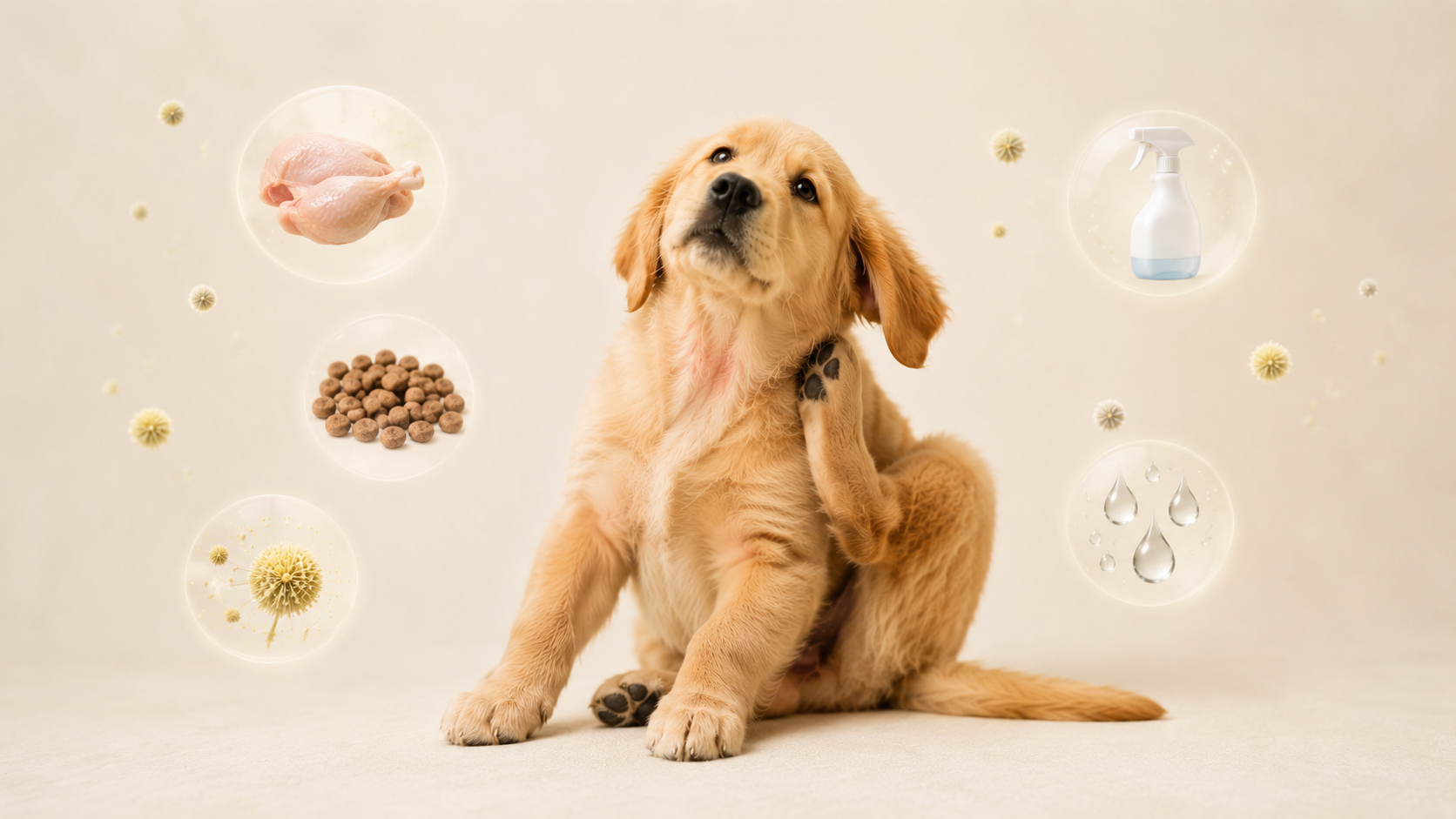
A dog who scratches the same spot, the same way, every day, is telling you something. The question is whether anyone is listening for the right answer.
Most pet parents in India whose dog starts itching go through a familiar sequence. A vet visit. An antihistamine. Sometimes a steroid. A different shampoo. A new “premium” kibble. Maybe a tick-and-flea preventative even when fleas weren’t the question. The itching gets a little better, then worse, then settles into a steady level. The dog never quite stops scratching.
The thing that almost never gets asked: what’s in the bowl.
The two-week rule
Dogs itch for lots of reasons. Some are one-offs, a stray flea bite, a contact reaction to a new shampoo, a bug in the grass. Most of those clear on their own within a few days.
A useful rule: if the itching has been going on for more than two weeks, and you’ve ruled out fleas with a proper preventative, you’re looking at something systemic, food, environment, or both. At that point the goal is not to suppress the itching. It’s to find the trigger.
2 weeks
the threshold past which itching is rarely a one-off, and almost always systemic
Two months in, the dog is also dealing with the secondary problems that come from chronic skin inflammation: thickened skin, yeast overgrowth, hot spots, fur loss, and infected ears. These are the consequences of the itch, not the cause. Treating only the consequences keeps the cycle going.
What vets usually check first: and what they tend not to check
A reasonable vet visit for an itchy dog goes through a sensible checklist: parasites (mites, fleas, lice), bacterial or fungal infections on the skin, allergies. Most vets will treat what they can see, antibiotic for an infected patch, antifungal for a yeasty paw, antihistamine for the inflammation, a steroid if the inflammation is severe.
What gets less attention: the systemic question. What is the immune system reacting to? In an Indian context, the food is usually the easiest answer to find, but the hardest one to ask, because it sounds like a marketing question rather than a medical one.
The honest version of the question is: “What protein has your dog been eating for the last six to twelve months, and have we considered eliminating it?” That’s a clinical question, not a brand question.
The food angle: and the chicken problem
Chicken is the #1 reported food allergen in dogs. It is also in roughly 80% of Indian pet food, including most of what’s marketed as “premium,” “natural,” and “complete and balanced.”
This is not a coincidence and it is not a conspiracy. Chicken is cheap. It’s palatable. It’s locally sourced. From a pet food manufacturer’s perspective, it’s the obvious protein. The problem is that the more chicken-based food a dog eats, the more chance their immune system has to develop a reaction to it.
A few specifics that surprise people:
- A dog can become allergic to a protein they’ve eaten happily for years. Allergies need exposure to develop. Long-term, repeated exposure is exactly the pattern.
- “Chicken” hides on labels. Look for “meat meal,” “animal fat,” “natural flavour,” “broth”, all of which can contain chicken without saying so.
- “Grain-free” doesn’t mean chicken-free. Most grain-free Indian dog food is still chicken-based.
- Treats and chews count. A dog on an otherwise chicken-free diet who gets one chicken-flavoured chew a day is not on an elimination.
The environment angle
Even if food is the primary trigger, the environment usually adds load. Four places to look:
Floor cleaners. Most Indian floor cleaners contain phenol, pine oil, or strong synthetic fragrances. Dogs walk on the wet floor and lick their paws. Cats are particularly vulnerable, they can’t metabolise phenols the way dogs can.
Read: Is phenyl safe for pets?
Fragrances. Agarbatti, dhoop, plug-ins, scented candles, perfume, hair products. Pets breathe these in continuously and absorb them through skin contact with sprayed fabrics.
Read: Fragrance allergies in pets
Detergents and softeners on bedding. Pets sleep on this fabric for half the day. Fragranced detergents and fabric softeners leave residue that contacts the skin for hours.
Read: Fabric softener and pet skin
Season. Allergic flare-ups in Indian pets cluster heavily in the monsoon. Humidity feeds yeast, mould bursts in damp corners, and the floors stay wet longer. A four-month seasonal protocol is often the difference between a dog who flares each year and a dog who doesn’t.
Read: Monsoon allergies in Indian pets
How to tell food from environment (or both)
There is no single test that separates these cleanly outside a vet’s office. But there are useful signals.
Probably food: if the itching is generalised, ear infections recur, the paws and face are involved, and there’s no clear seasonal pattern. The single biggest tell: the dog has been on a chicken-based food for a year or more and the symptoms started months in.
Probably environment: if the itching has a clear seasonal pattern (worst in monsoon, better in winter), is concentrated where the dog touches the floor, or coincided with a household change (new cleaner, new candle, new mattress, a renovation).
Probably both: most cases. If you change one variable and see partial improvement, the other variable is also active. This is normal and is not a reason to give up.
What the pattern usually means
Look for
- Year-round itching with no clear seasonal pattern
- Recurring ear infections, brown or yeasty discharge
- Itching that includes paws, ears, face, belly
- Loose stools or chronic gas alongside skin signs
Avoid
- Itching that flares only in monsoon season
- Itching concentrated where the dog touches the floor
- Sneezing, watery eyes, hay-fever-like signs
- A flare that started after a household change
Left column leans food. Right column leans environment.
If you want a structured starting point, the Allergy Check walks through the same questions a vet might if they had thirty minutes per visit instead of seven.
What to actually do this week
Three changes, in parallel, for two weeks:
- Read the food label. If chicken or any chicken-derived ingredient is in the first three, you have your strongest food hypothesis. Plan an 8-week elimination with a novel protein. Don’t start it this week, read on it first so you do it right.
- Change the floor cleaner. Either switch to a pet-safe one or skip cleaner entirely and use plain water for two weeks as a test. Wipe paws after every walk.
- Wash the dog bed in fragrance-free detergent. No softener. Drop any agarbatti, candles, and plug-ins from the dog’s main room.
Watch for two weeks. You’re looking for direction, not a miracle. “Slightly better” is a useful signal. “No change at all” is also useful, it tells you food is your next test.
The fix is rarely fast. It’s almost always findable.
When to escalate to a vet
Most chronic itching is a checklist problem. Some isn’t.
Vets can run skin scrapes, fungal cultures, and (where available) refer to a dermatologist for a serum allergy panel or an intradermal skin test. These are useful and can shortcut weeks of guesswork. They do not replace the elimination diet, but they complement it.
Read: When to take your itchy pet to the vet, and what to actually ask
What “fixed” looks like
Fixed isn’t always “no symptoms ever.” For a dog whose food and home have been right-sized, fixed usually looks like:
- No daily scratching as a baseline.
- No recurring ear infections.
- Paws that stay light-coloured between the toes.
- A flare or two a year (often around weather changes), short and self-resolving.
That is achievable for most dogs. It takes weeks to months, not days. It is mostly a matter of finding what the immune system is reacting to and removing it, quietly, methodically, one variable at a time.
If you’re at the start of this work, take the Allergy Check. If you’re a few months in and stuck, see a vet about a referral. Either way, the question to keep asking, the one that doesn’t usually get asked, is what’s in the bowl.
This article is education, not diagnosis. If symptoms persist or worsen, please see your vet.
Frequently asked
How long should I wait before assuming food is the cause? +
Two weeks of consistent itching with no flea or injury explanation is enough to take seriously. Two months is enough to act. Don't wait for it to get worse, chronic skin inflammation gets harder to fix the longer it runs.
Can a dog be allergic to chicken even if they've eaten it for years? +
Yes. Food allergies in dogs typically need long, repeated exposure to a protein to develop. 'But she's eaten this for years' is not an argument against the food being the cause, it's actually how food allergies usually present.
Will antihistamines fix the underlying issue? +
No. Antihistamines and steroids reduce the symptom by suppressing the immune response. They do not address what's setting off the immune response in the first place. They are useful as short-term breathing room while you investigate the cause; they are not a long-term answer.
Is grain-free pet food the answer? +
Usually not. Most Indian pet food labelled 'grain-free' still contains chicken, which is the most common food allergen. Grain itself is rarely the trigger. 'Grain-free' is a marketing choice, not a medical one.
What about flea allergy? +
Flea bite hypersensitivity is real and common, a single flea can set off an itchy dog for weeks. Rule it out with a high-quality preventative for at least two months before assuming the cause is food or environmental. If a good flea preventative doesn't change anything, you have your answer.
Niko's story is what started ode. Read it →
Related reading
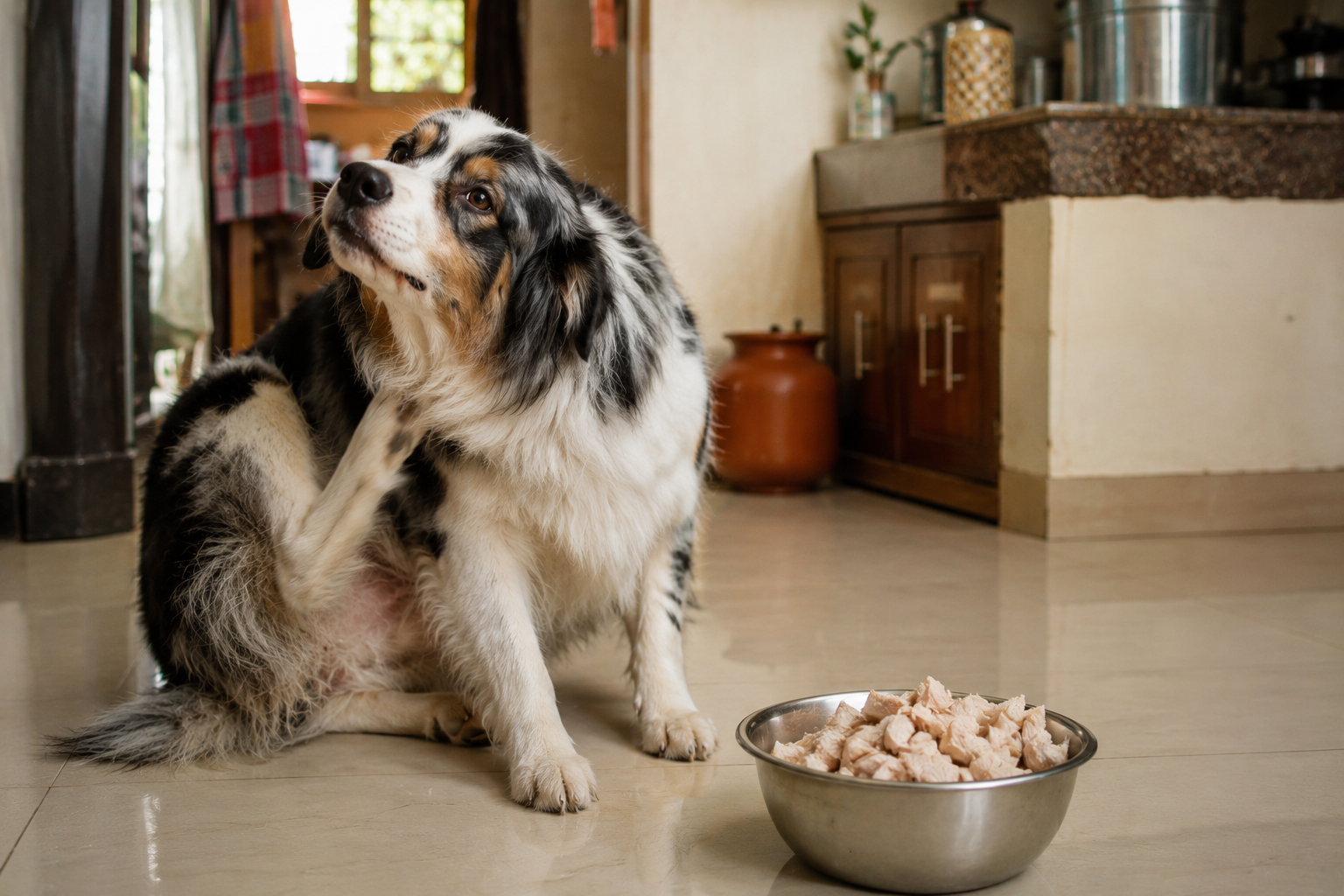
Chicken allergy in dogs: signs, why it's everywhere in India, and what to try
Symptoms of chicken allergy in dogs, why chicken dominates Indian pet food, what 'grain-free' really means, and the 6–8 week elimination check.
9 min read
When to take your itchy pet to the vet, and what to actually ask
When itching crosses into a vet visit, what notes to bring, and the five questions that make the difference between a steroid script and a real plan.
9 min read

Hidden chicken: the ingredients that mean chicken without saying chicken
Natural flavour, animal fat, meat meal, poultry by-product: the label words that hide chicken in Indian pet food, treats, and prescription diets.
8 min read