Chicken allergy in dogs: signs, why it's everywhere in India, and what to try
Chicken is the #1 reported food allergen in dogs and is in roughly 80% of Indian pet food. The two facts collide on a lot of dinner bowls.
· 9 min read
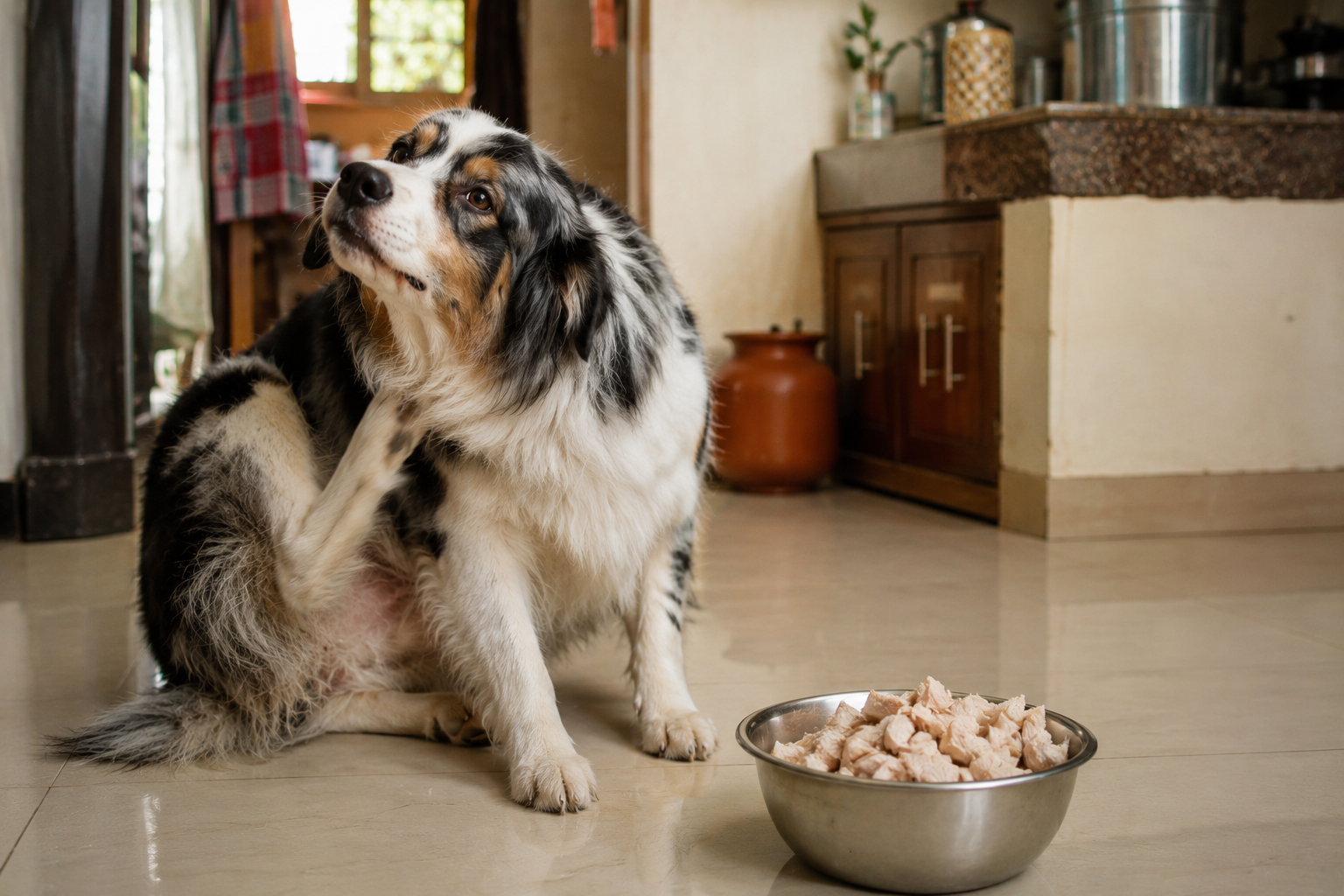
There is no allergy in dogs that comes up more than chicken. There is no protein in Indian pet food that comes up more than chicken. The overlap is not a coincidence and the consequences are visible on a lot of paws, ears, and bellies across the country.
This is what a chicken allergy actually looks like, why chicken dominates Indian pet food, what “grain-free” doesn’t fix, and the 6–8 week elimination that confirms or rules it out.
Why chicken is so often the trigger
Food allergies in dogs are an immune-mediated reaction to a specific protein. The dog’s body has, over time, decided that protein is foreign and worth attacking. The most reliable way to develop a food allergy to a protein is to eat that protein in large amounts, repeatedly, for a long time.
Chicken is the protein that meets all three conditions for the most Indian dogs.
It dominates supermarket and pet-store kibble, including the brands marketed as “premium,” “natural,” and “complete and balanced.” It dominates wet food, treats, and chews. It even dominates the prescription weight-control and dental ranges. A dog whose owner has been carefully picking food for years has very likely been picking chicken-based food for years.
The result, in clinical reports globally, is that chicken sits at or near the top of food allergens in dogs alongside beef, dairy, and lamb. In India, the chicken share is even more lopsided because the Indian pet food market is so chicken-heavy.
80%
of Indian pet food contains chicken, the #1 reported food allergen in dogs
The symptoms that point at food, not environment
Food allergies and environmental allergies overlap in symptoms, both can produce itching, ear infections, and inflamed paws. There are still some patterns that lean toward food.
Food or environment?
Look for
- Year-round symptoms, no clear seasonal pattern
- Recurring ear infections with brown or yeasty discharge
- Generalised itching: face, paws, belly, armpits, groin, tail base
- Loose stools or chronic gas alongside skin signs
- Improves when boarded somewhere else and fed differently
Avoid
- Clear seasonal pattern, worst in monsoon
- Itching concentrated where the dog touches the floor
- Flare after a household change: new cleaner, mattress, agarbatti
- Sneezing, watery eyes, hay-fever-like signs
Most cases are a mix. If you can only test one thing first, food usually gives the cleanest signal because you can hold the home variables constant for the duration of the trial.
What chicken hides in
This is where labels get hard. The seven words to watch for on Indian pet food labels:
- Chicken: obvious.
- Chicken meal: chicken meat and bone, dried and ground. Counts as chicken.
- Chicken by-product / chicken by-product meal: non-meat parts of the chicken (organs, feet, heads). Counts as chicken.
- Poultry / poultry meal: usually chicken, sometimes turkey. Counts.
- Meat meal without a species named, could include chicken. Treat as suspect during an elimination.
- Animal fat without a species named, could be chicken fat. Treat as suspect.
- Natural flavour: often hydrolysed chicken. Treat as suspect.
If a label says “duck and rice” but lists “natural flavour” or “animal fat” without specifying the species, you do not have a chicken-free food. The strict elimination requires a label that names every animal source explicitly.
Read: Hidden chicken, the ingredients that mean chicken without saying chicken · Read: How to read an Indian pet food label
Why “grain-free” doesn’t fix this
Grain, wheat, corn, rice, is rarely the actual driver of a dog food allergy. The grain-free trend was driven by marketing, not by clinical evidence. The reactions that get attributed to grain are almost always reactions to the protein in the same food.
The problem with “grain-free” as a solution is that nearly every grain-free Indian kibble is still chicken-based. Switching from chicken-and-rice to chicken-and-sweet-potato changes nothing about the trigger. It just rearranges the carbs.
If grain-free is part of a dog’s diet for a real reason, for example a confirmed corn or wheat sensitivity, or a vet’s prescription, fine. As a generic answer to itching, it isn’t.
Single-protein alternatives in India
To run an elimination diet (or just to switch off chicken), you need a single, named, non-chicken protein. What’s actually buyable in India varies by city, but the common categories are:
Mutton / goat
The most accessible novel protein in India. Fresh at any market, widely available in dry food. Check your dog hasn't eaten it in the past year.
Fish
Mackerel, sardines, and rohu are fresh and affordable across India. Genuinely novel for most dogs raised on chicken kibble. Salmon available in dry food.
Venison
Niche but available in some specialty stores and online. A strong novel option if your dog has had mutton before.
Rabbit
Harder to source consistently but a valid option. Most useful when other novel proteins have already been exhausted.
For home-cooked diets, fresh fish (mackerel or sardines) and fresh mutton (goat) are the most practical novel proteins in India: affordable, widely available at any market, and genuinely unfamiliar to most dogs raised on chicken kibble.
For an elimination, you want a protein your dog has truly never eaten before. If your dog has had mutton or lamb at any point in the last year, those may not be novel. Pick the most distant protein you can reliably source for two months.
Read: Novel proteins in India, what to actually feed an allergic pet
Picking a protein for the trial
Look for
- Single named protein on the label (e.g. only mutton)
- Fresh fish: mackerel, sardines, rohu
- Goat (mutton) from a market you trust
- A protein your dog has demonstrably never eaten
Avoid
- Anything labelled 'natural flavour' or 'animal fat'
- 'Meat meal' or 'poultry' without species named
- Lamb or mutton if your dog has eaten it in the past year
- Multi-protein blends sold as 'novel'
A note on home-cooked: home-cooked elimination diets are a real option in India, especially when novel-protein commercial food is hard to source. They take more work and need to be balanced: at minimum, the protein, a single carb, a fat source, and a basic vitamin/mineral supplement. Talk to your vet before doing this for more than a few weeks.
The 6–8 week elimination check
This is the standard test. The full walkthrough is here: The elimination diet for dogs. The short version:
Phase 1, elimination (8 weeks). A single, novel protein and a single carbohydrate. Nothing else passes your dog’s lips. No treats. No flavoured medications. No table scraps. No chicken-based chews. No pill pockets unless they match the elimination.
Phase 2, observation (during weeks 4–8). Track itching, ear flares, paw licking, stool quality. Most food-allergic dogs improve clearly by week 4–6. Some take the full 8 weeks.
Phase 3, reintroduction (weeks 8 onward). Reintroduce one ingredient at a time, every 7–14 days. Watch for flares. The flare is the answer.
The strict version is the only version that gives clean information. One chicken treat midway through the trial resets the clock. This sounds harsh; it is. It is also the difference between knowing and guessing.

What to do if you swap and nothing changes
If you’ve run a careful 8-week elimination on a confirmed novel protein and seen no improvement, the food is probably not the primary driver, or not the only one. Next steps:
- Check for environmental load. Floor cleaner, fragrances, fabric softener, dust mites, monsoon humidity. The four-week environmental audit can run alongside or after the food trial.
- Look at the secondary problems. Yeast on the paws or in the ears, a low-grade bacterial skin infection, these can keep the symptoms going even after the trigger has been removed.
- See a vet about a referral. A veterinary dermatologist can run a serum allergy panel (less reliable for food, more useful for environmental allergens) or an intradermal skin test. They can also discuss hydrolysed-protein prescription diets if a true novel protein is hard to find.
What this week looks like
If you’re at the start of this and reading the label of your dog’s food for the first time, here’s a useful sequence:
- Read the first three ingredients of the food. Note whether chicken is in any of them.
- Read the rest of the label. Note any “natural flavour,” “animal fat,” “meat meal,” or “by-product” that doesn’t name a species.
- Read the label of every treat, chew, and pill pocket in the house. Same questions.
- Buy a single bag of a single-protein non-chicken food (the smallest bag you can find, in case your dog won’t eat it).
- Plan an 8-week elimination, including how you’ll handle medications, walks, neighbours feeding scraps, and the dog who does not enjoy change.
Take the 2-minute Allergy Check
The honest version
Most chicken-allergic dogs in India have been chicken-allergic for a while before anyone identified it. The food market is set up to make chicken the default. The vet visit is set up to treat the symptom. The dog is set up to be uncomfortable.
The fix is not difficult. It is mostly stubborn. Pick a protein, hold the line for eight weeks, and watch what happens. Most of the dogs who get clean information from that trial don’t need to do it again.
This article is education, not diagnosis. If symptoms persist or worsen, please see your vet.
Frequently asked
How quickly can a chicken allergy develop? +
Months to years. Allergies need long, repeated exposure to develop, which is why a dog can become allergic to a protein they've eaten happily for years. The trigger is the cumulative exposure, not the brand.
Can my dog be allergic to chicken but not to eggs? +
Yes. Chicken meat and eggs are different proteins. Some dogs react to one and not the other. During an elimination diet, treat them as separate variables, eliminate both, then reintroduce one at a time.
Is fish or mutton really better for an allergic dog? +
Better in the sense of being less likely to be a current allergen, yes. There's nothing magical about fish or mutton; they're just less commonly eaten by Indian dogs on chicken-led diets and so less likely to have triggered an existing allergy. The honest framing is 'novel,' not 'better.'
What is hydrolysed protein dog food? +
Hydrolysed-protein diets break the protein down into pieces small enough that the immune system typically does not recognise them. They are prescription-only, expensive in India, and used in difficult cases or when a true novel protein is hard to source. They are an option, not a first resort.
If I switch the food and my dog improves, was it definitely chicken? +
Likely, but not proven. The clean way to confirm is to reintroduce chicken alone for 7–14 days after the elimination clears symptoms. If symptoms return, you have your answer. Most pet parents skip this step, which is fine if you don't need certainty, but the reintroduction is the actual test.
Niko's story is what started ode. Read it →
Related reading
The elimination diet for dogs: an 8-week, India-friendly walkthrough
How to do an elimination diet for a dog with suspected food allergy in India, choosing a protein, the no-exceptions rule, week-by-week expectations, and the reintroduction phase.
12 min read
Novel proteins in India: what to actually feed an allergic pet
Novel protein options for allergic dogs and cats in India: fish, mutton, rabbit, why duck isn't a real option here, sourcing, prep, and the 8-week trial rule.
9 min read

Hidden chicken: the ingredients that mean chicken without saying chicken
Natural flavour, animal fat, meat meal, poultry by-product: the label words that hide chicken in Indian pet food, treats, and prescription diets.
8 min read