The elimination diet for dogs: an 8-week, India-friendly walkthrough
A single, never-eaten-before protein and a single carb for 8 weeks. No exceptions. The cleanest test for food allergy you can run at home.
· 12 min read

The elimination diet is the single best test you can run at home for a suspected food allergy in a dog. It’s not glamorous and it’s not fast. It is reliable, it costs only the price of food, and it tells you something a vet visit usually can’t.
This is a complete walkthrough, what it is, why it has to be strict, what to choose for your dog in India, the week-by-week expectations, the reintroduction phase that makes the test useful, and what to do when 8 weeks pass and nothing has changed.
What an elimination diet is (and isn’t)
An elimination diet is a diagnostic tool. The goal is to remove every possible food allergen from your dog’s diet for long enough, typically 8 weeks, that the immune system has time to settle. If symptoms clear, food was the trigger, and the next phase tells you which food.
What it isn’t:
- A long-term diet. Most novel-protein elimination foods are not meant to be the dog’s diet for life. The point is to identify, then customise.
- A weight-loss plan. Don’t combine elimination with caloric restriction; you want one variable changing at a time.
- A detox. Allergies don’t work that way; nothing is being “flushed.”
- A test for environmental allergies. A food elimination doesn’t address dust mites, fragrance, or floor cleaner. If symptoms don’t improve, the next thing to test is the environment.
It is, fundamentally, a structured way to remove a variable and watch what happens.
Choosing a novel protein in the Indian context
The protein needs to be one your dog has not eaten in any form, ever (or at least not in the last year, true never-eaten-before is the gold standard but isn’t always practical).
What’s typically available in India, in approximate order of accessibility:
- Lamb or mutton: widely available in dry food and some wet food, and easy to source fresh for home-cooked diets. Check whether your dog has had it before, as it’s increasingly common in commercial brands.
- Fish: mackerel, sardines, and rohu are accessible fresh across most cities and genuinely novel for many Indian dogs. Salmon and ocean fish blends are available in dry food too.
- Venison: niche, available through specialty stores and online.
- Rabbit: niche, harder to source consistently.
For home-cooked elimination, fresh fish (mackerel, sardines) and fresh mutton (goat) are among the most practical choices in India: widely available, affordable, and genuinely novel for most dogs on a chicken-led diet.
If your dog has been eating a chicken-led food for years and has had occasional fish or mutton in treats, those may not be truly novel. Pick the most distant protein you can find and reliably source for two months.
Read: Novel proteins in India, what to actually feed an allergic pet
For the carbohydrate, you want one source. Common single-carb pairings:
- Sweet potato
- White potato
- Tapioca
- Brown rice (if not previously eaten)
- Oatmeal (if not previously eaten)
Avoid pairings with multiple carbs in the same food. The simpler the recipe, the cleaner the signal.
The “no exceptions” rule and why one chicken treat resets the clock
This is the part most pet parents underestimate.
What goes in the bowl for 8 weeks
Look for
- The novel-protein food, commercial or home-cooked
- Plain water
- Pill pockets only if they match the elimination protein
- Unflavoured monthly medications (ask your vet)
Avoid
- Treats of any kind, even 'small' ones
- Flavoured medications, toothpaste, dewormers
- Bones, chews, rawhides, table scraps
- Cheese, peanut butter, yoghurt, the piece of toast that fell
The reason for this strictness is simple: the immune system reacts to even small amounts of an allergen. A single chicken-flavoured treat midway through the trial keeps the inflammation going. You’ll see no improvement and conclude the elimination didn’t work, when in fact the elimination wasn’t really tried.
If you can’t realistically run a strict elimination, because of the household, the dog’s habits, or a co-dog whose food gets shared, be honest with yourself before you start. A loose elimination produces a loose result. If you decide to do it, commit fully for 8 weeks.
Week-by-week: what to expect, what to track, when to worry
Eight weeks, ordered
-
Week 1
Transition
- Move from old food to new food gradually over 5-7 days.
- Mix increasing portions of new with decreasing portions of old.
- Track stool quality, appetite, energy. Looser stools the first week is normal.
-
Week 2
Settle in
- Now fully on the elimination food.
- No skin improvement expected yet, the immune system is still clearing the previous protein.
- Track itching frequency informally. 'A lot', 'a bit', 'noticed once today' is fine.
-
Weeks 3-4
Earliest signal
- Earliest a clear food-driven improvement might show.
- Watch for: paws calmer, ear less smelly, fewer scratches a day.
- Note any flare days and what happened around them. Variables matter.
-
Weeks 5-6
Clear improvement window
- Most food-allergic dogs show clear improvement by now.
- Take a photo of paws, ears, and any inflamed skin.
- Compare to a photo from week 0. Photographs are more honest than memory.
-
Weeks 7-8
Decide
- Symptoms clearly better, run the reintroduction phase next.
- Symptoms slightly better, extend 2-4 weeks before reintroducing.
- Symptoms unchanged, food is probably not the primary driver. Move to environmental work.
The reintroduction phase: how to identify the actual trigger
This is what makes the elimination useful. Without reintroduction, you have a diet that worked but no certainty about which ingredient was the issue.
The protocol:
Week 1 of reintroduction. Add the dog’s previous main protein back into the food. If it was chicken, add small amounts of plain cooked chicken (no seasoning, no oil, no skin). Start with about 30g and increase daily.
Watch for 7–14 days. A reaction to the protein typically shows within 1–10 days. Look for:
- A return of itching.
- A flare of paws.
- An ear suddenly smelling again.
- Loose stools.
If you see a reaction, stop the reintroduction and remove that protein. You’ve found a trigger.
If you see no reaction over 14 days, that protein is not a trigger. Pause the reintroduction, hold for a few days on the elimination food alone, then introduce the next ingredient.
Reintroduce in this order, generally:
- The previously-eaten protein you suspect (usually chicken).
- The next most-eaten protein (often beef or lamb).
- Dairy.
- Grain (rice, wheat).
- Egg.
Each ingredient gets its own 7–14 day window. Yes, this takes weeks. The information is worth it.
Weekly symptom tracker
Print this or copy it to a notes app. Fill it in every Sunday. Take a photo of the paws, the inside of the ears, and any inflamed skin on Week 0, then again on weeks 4 and 8. Photos are more honest than memory.
| Week | Itching none / some / often / constant | Paw licking none / 1 paw / several / all 4 | Ears clean / smelly / shaking | Stools firm / soft / loose | Notes slips, candles, visitors, etc. |
|---|---|---|---|---|---|
| Week 0 Baseline. Take photos today. | |||||
| Week 1 | |||||
| Week 2 | |||||
| Week 3 | |||||
| Week 4 Take photos. Compare to week 0. | |||||
| Week 5 | |||||
| Week 6 | |||||
| Week 7 | |||||
| Week 8 Final photos. Decide on reintroduction. |
What each column is tracking and why:
Itching is the headline metric, but it is also the least precise. A pet parent’s read of “itching a lot” can shift over eight weeks as tolerance builds. Keep it calibrated by asking the same question each week: how many times did you notice them scratch today? Paw licking is easier to count and often the clearest early signal. Ear notes tell you whether a flare is building before it becomes a full infection. Stool quality is the most reliable gut-level signal and often the first thing to improve when the right food is found. The Notes column is where most eliminations are won or lost: every slip, every neighbour feeding scraps, every new candle lit goes in there.
Your vet will ask for exactly this kind of record. Coming in with eight weeks of notes and three comparison photographs is worth more than a verbal summary of “she seems a bit better.”
What to do if 8 weeks pass with no change
If you’ve run a strict elimination on a confirmed novel protein for 8 weeks and seen no improvement:
- Food is probably not the primary driver. Don’t write it off entirely, environmental load can mask food signals, but the leading hypothesis shifts.
- Move to environmental work. Floor cleaner, fragrance, fabric softener, dust mites, monsoon humidity. The four-week environmental audit can run alongside or after.
- Talk to your vet about a serum allergy panel for environmental allergens. Less reliable for food, more useful for dust mites, pollens, moulds.
- Consider a hydrolysed-protein prescription diet as a stricter test, the protein is broken so small that the immune system can’t recognise it, removing the “novel-protein-but-not-novel-enough” loophole.
- Look at secondary issues. Yeast on the paws, low-grade bacterial skin infection, these can keep symptoms going even after the trigger is gone. They sometimes need treatment in parallel.

A note on home-cooked elimination
For Indian pet parents, home-cooked elimination is sometimes the most practical option, especially if novel-protein commercial food is hard to find consistently in your city.
A balanced home-cooked elimination diet at minimum includes:
- The novel protein, cooked plain (no oil, no salt, no spice).
- The single carbohydrate.
- A fat source (a small amount of fish oil or coconut oil).
- A vitamin-mineral supplement appropriate for dogs (your vet can advise).
- Adequate calcium (often via a calcium carbonate supplement or finely ground egg shell, but talk to your vet about quantity).
Home-cooked is fine for the 8-week trial. For longer-term feeding, get a balanced recipe from a veterinary nutritionist, the supplement and calcium ratios matter and are easy to get wrong.
What this week looks like
If you’re starting an elimination this week:
- Pick your novel protein. Ideally one your dog has truly never eaten, sourced from a supplier you can rely on for two months.
- Buy one bag (or arrange one round of home-cooked supplies). Smallest you can find, your dog might refuse it.
- Get unflavoured versions of any monthly medications.
- Tell anyone in the household: no treats, no scraps, no exceptions, for 8 weeks.
- Take photos of paws, ears, and any inflamed skin today. Date them.
- Plan a weekly check-in (10 minutes, every Sunday) to update the symptom journal.
Take the 2-minute Allergy Check, useful before starting, to help you decide whether food is your strongest hypothesis.
The elimination diet is mostly about being stubborn for two months.
This is one of the most reliable tests in pet nutrition for a reason. Most pet parents who run it cleanly come out the other side either with a clean answer (and a happier dog) or with a clear next variable to check. Either is better than another year of antihistamines.
This article is education, not diagnosis. If symptoms persist or worsen, please see your vet.
Frequently asked
Can I do an elimination diet with home-cooked food? +
Yes, and many Indian pet parents do, partly because true novel-protein commercial food can be hard to source consistently. A balanced home-cooked elimination needs the protein, a single carb, a fat source, and a vitamin-mineral supplement. Talk to your vet before doing this for more than a few weeks; balance matters.
Why does the diet need to be so strict? +
Because the immune system reacts to even small amounts of an allergen. One chicken treat midway through is enough to keep the inflammation going and muddy the result. The strict version is the only version that gives you clean information.
What if my dog refuses the new food? +
Common, especially in dogs used to a strong-smelling food. Transition slowly over 7–10 days, mixing increasing portions of the new food with decreasing portions of the old. If your dog truly won't eat it after a fair attempt, try a different novel protein. Don't compromise by adding old food back.
Is hydrolysed protein an alternative? +
Yes. Hydrolysed-protein prescription diets break the protein into pieces too small for the immune system to recognise. They are an option when a true novel protein is hard to source, or when prior elimination attempts haven't worked. They are prescription-only and more expensive. Talk to your vet.
How do I know it's working at week 4? +
Look for direction, not perfection. Less itching, fewer ear flares, paws less inflamed, more settled sleep. A clear improvement by week 4–6 is a strong signal. No improvement by week 8 means food is probably not the primary driver, and environmental work moves up the priority list.
Niko's story is what started ode. Read it →
Related reading

Novel proteins in India: what to actually feed an allergic pet
Novel protein options for allergic dogs and cats in India: fish, mutton, rabbit, why duck isn't a real option here, sourcing, prep, and the 8-week trial rule.
9 min read

Hidden chicken: the ingredients that mean chicken without saying chicken
Natural flavour, animal fat, meat meal, poultry by-product: the label words that hide chicken in Indian pet food, treats, and prescription diets.
8 min read
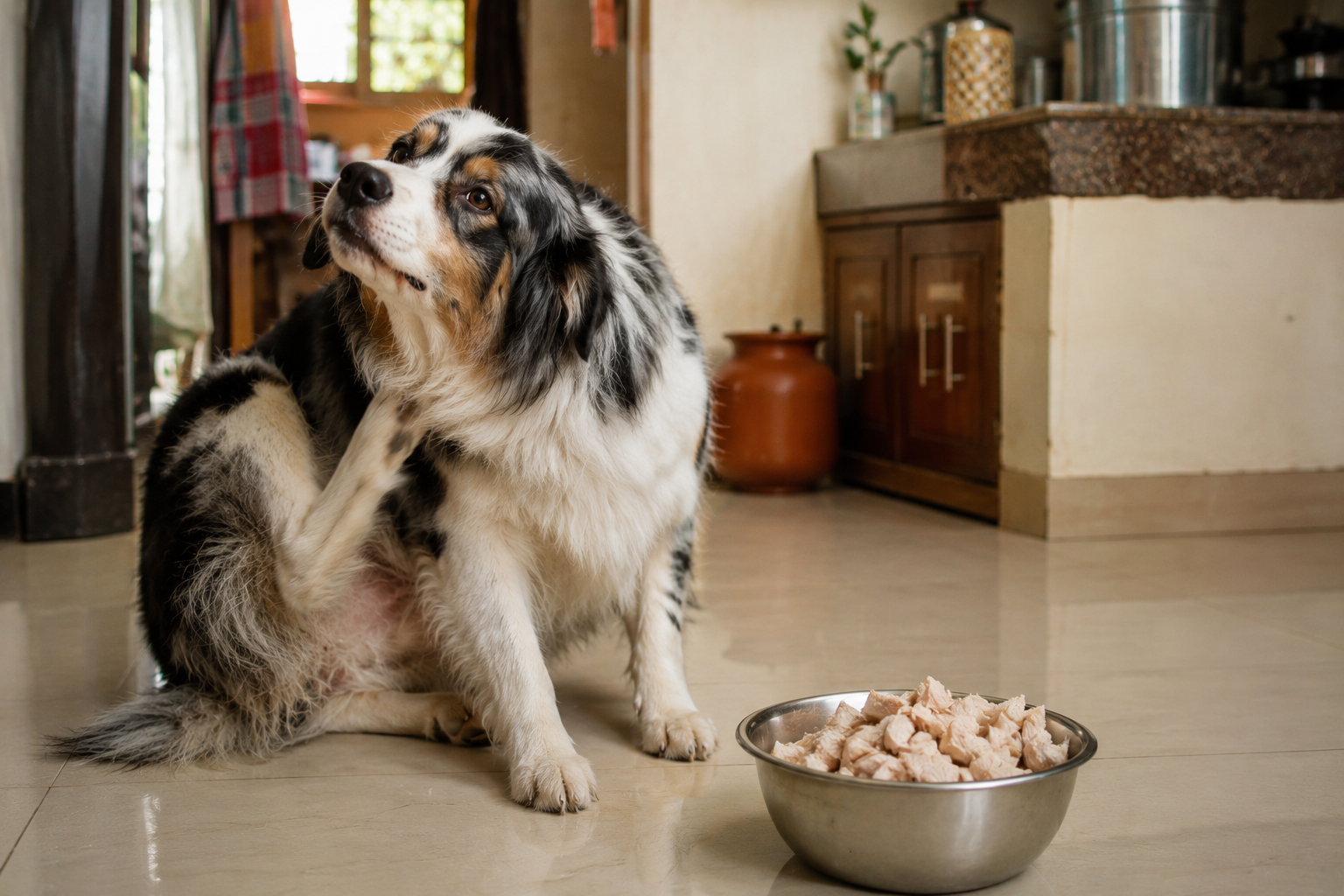
Chicken allergy in dogs: signs, why it's everywhere in India, and what to try
Symptoms of chicken allergy in dogs, why chicken dominates Indian pet food, what 'grain-free' really means, and the 6–8 week elimination check.
9 min read