Why most Indian dog treats are off-limits during an elimination diet
You switched the food. You kept the treats. That's why the test isn't working.
· 7 min read
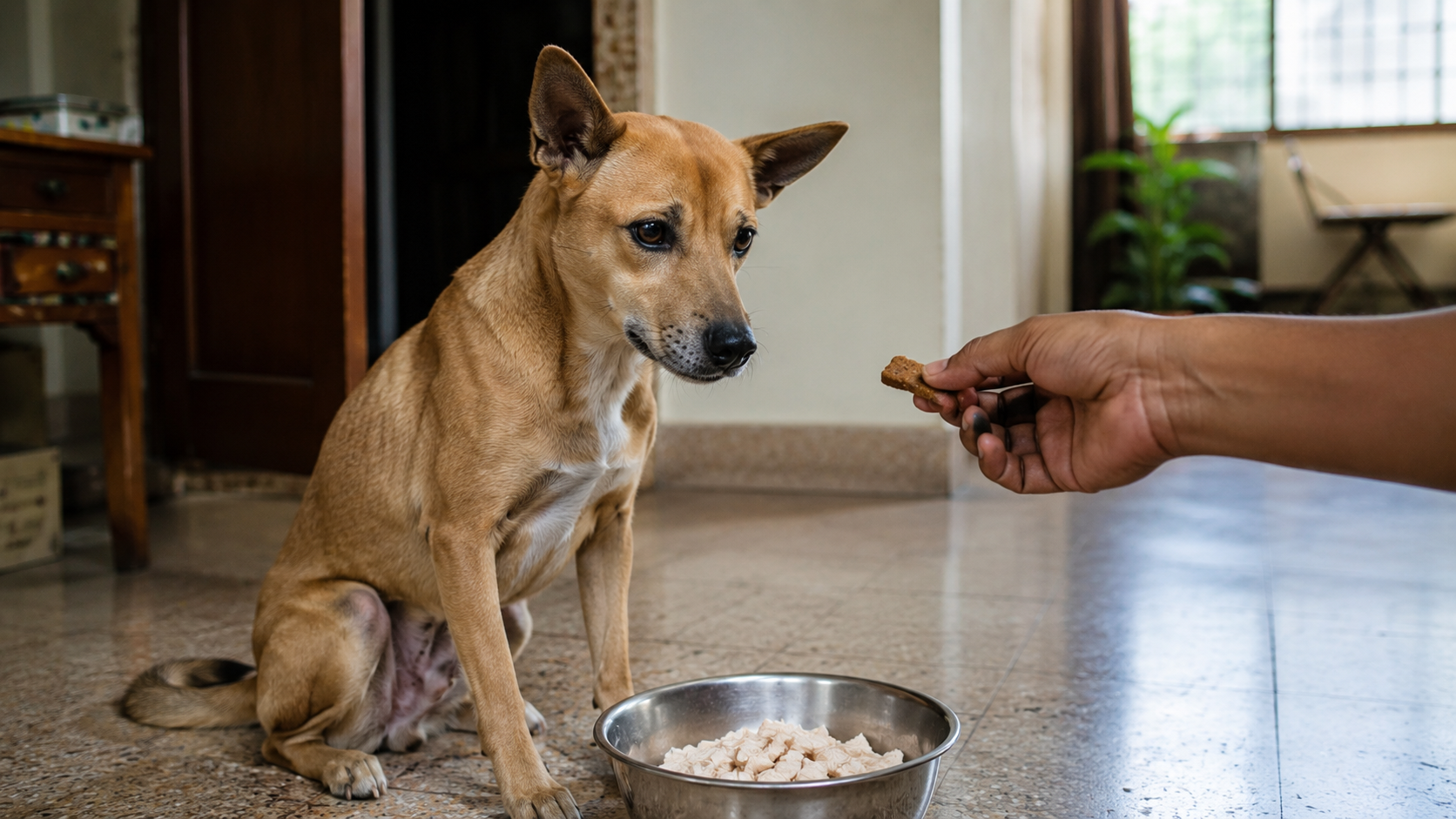
The elimination diet has one rule that overrides every other: nothing passes your dog’s lips except the single novel protein and carbohydrate you’ve chosen. One undisclosed chicken ingredient in a treat resets the clock. Eight weeks start again.
Most pet parents know this in theory. In practice, the treats get overlooked because the treats don’t feel like food. They’re rewards. They’re training tools. They come in small packages that don’t look like the 10kg bag you switched out. And in India, almost all of them contain chicken.
Almost all
mainstream Indian dog treats use chicken as their primary ingredient — including many that don't say so on the front.
What’s actually in Indian dog treats
The mainstream treat brands sold at every pet store and delivered by every online platform tell the same story.
JerHigh is Thailand’s largest-selling dog treat in India and a staple on every pet store shelf. Every JerHigh product uses chicken meat as its primary ingredient. The Bacon Stix are chicken. The Liver Stix are chicken. The Milk Stix are chicken. The “strip with real chicken meat” is, at least, honest about it.
HUFT’s own biscuit line, the Yummy in My Tummy range, leads with chicken liver. Their Sara’s Doggie Treats are 100% chicken breast jerky. Their Berry Bites are chicken with raspberries. Even the training-friendly formats.
Chip Chops: chicken is ingredient one. Drools jerky and training treats: chicken. Pedigree treats: chicken-based. Purepet biscuits: chicken.
Supertails’ jerky category page is titled “Chicken, Lamb & Mutton.” Chicken comes first because chicken is the default. Lamb and mutton are the alternatives people have to seek out.
The label problem is worse than it looks
Switching from a chicken-flavoured treat to one that doesn’t say chicken on the front is not enough.
Read: Hidden chicken, the ingredients that mean chicken without saying chicken · Read: How to read an Indian pet food label
The facility question nobody asks
There is a further problem that no label addresses: shared production.
A lamb jerky or a fish biscuit made in the same facility as chicken products carries contamination risk that no ingredient list will disclose. Indian pet food labelling does not require facility allergen statements. International “may contain traces of” disclosures are rare and inconsistent in this market.
This matters most when you are running a strict 8-week elimination. The point of the elimination is to remove every possible source of the suspected allergen. A treat that is technically lamb-flavoured but packed on the same line as chicken products is an unknown variable, and unknowns ruin the test.
What is actually available if you need allergy-friendly treats
Very little at the mainstream level.
Vivaldis (Bark Out Loud) makes a Mini Fishes treat that is explicitly labelled grain-free and hypoallergenic. It is one of the few mainstream products that positions itself anywhere near an allergy audience. But even here: read the full ingredient list before using it during an elimination.
Some fish-based and mutton-based jerky options exist on Supertails and Heads Up For Tails, though these are a small fraction of the treat aisle and the facility question still applies.
At the prescription end, Farmina Vet Life and Hill’s z/d and Royal Canin Hypoallergenic all make food for confirmed allergy cases. These require a vet prescription and run significantly more expensive than standard food. They are not designed for the discovery phase. They are the medical response to a known diagnosis.
What to use instead
The simplest answer is to make your own treats from the elimination food.
If your dog is on mackerel and rice, the training treat is a small piece of plain cooked mackerel. If the elimination is mutton and sweet potato, the training reward is a small cube of plain cooked mutton. No separate product, no unknown ingredients, no facility question.
Fresh treats made from the elimination protein:
- Keep in the fridge for up to 3 days
- Can be frozen in small batches for the week ahead
- Work as well as commercial treats for training if the dog is food-motivated
Plain cooked carrot or cucumber, if vegetables are part of the elimination or at least verified not to be a trigger, is a reasonable low-calorie option for dogs who need high treat volume during training.
Raw carrots are also worth knowing about for dogs who need something to chew: not a protein source, not likely to interfere with most eliminations, and reasonably good for teeth.
How one treat undoes eight weeks
Food allergies are immune-mediated. The immune response to a protein doesn’t care about dose. A full bowl and a single treat deliver the same signal to the immune system: the protein is present. The inflammation that follows is the same inflammation you are trying to clear.
The elimination requires 8 weeks without the trigger protein because it takes that long for the inflammatory response to fully settle in most dogs. An exposure midway through, even a small one, can restart the process. The timeline resets, not pauses.
This is not a reason to avoid eliminations. It is a reason to be serious about treats before you start, not three weeks in.
The gap in the Indian market
There is currently nothing on Indian shelves at the mainstream level that is designed for a dog in the elimination phase: chicken-free, facility-verified, clearly labelled, and accessible without a vet prescription. That gap is real.
Until it is filled, the safest treat is the one you make at home from the food you already know is clean.
Take the 2-minute Allergy Check to find out which triggers are most likely for your pet.
Read: The 8-week elimination diet for dogs
This article is education, not diagnosis. If symptoms persist or worsen, please see your vet.
Frequently asked
Can I use training treats during an elimination diet? +
Only if the treat is made from the exact same protein as the elimination food, with no other animal ingredients listed. Most commercial training treats in India use chicken. A safer option is to use small pieces of the elimination food itself, plain cooked fish or mutton cut small, as a training reward.
My dog's food says 'lamb' but the treat says 'natural flavour.' Does that matter? +
It does. 'Natural flavour' in Indian pet food is frequently hydrolysed chicken. If the treat lists 'natural flavour,' 'animal fat,' or 'meat meal' without naming the species, it is not safe to use during a chicken elimination. The label on the front means nothing if the ingredient list doesn't name every animal source.
What about dental chews during the elimination? +
Most popular dental chews in India, including major branded options, contain chicken-derived ingredients. Read the full ingredient list. If any animal source is unnamed, the chew is off-limits for the duration. Plain raw carrots are a reasonable dental substitute for many dogs.
Are freeze-dried treats safe? +
Only if the single ingredient is the same protein as the elimination. Some freeze-dried fish or mutton options are available online. Read the label carefully, even freeze-dried products can include flavour additives or be packed in shared facilities.
What about treats made in a different facility from the main food? +
A treat and a food can be made in entirely different facilities, each with their own contamination risk profile. The safest approach during an 8-week elimination is to use food from the elimination itself as the only reward, not a separate product.
Niko's story is what started ode. Read it →
Related reading

Hidden chicken: the ingredients that mean chicken without saying chicken
Natural flavour, animal fat, meat meal, poultry by-product: the label words that hide chicken in Indian pet food, treats, and prescription diets.
8 min read
Chicken allergy in dogs: signs, why it's everywhere in India, and what to try
Symptoms of chicken allergy in dogs, why chicken dominates Indian pet food, what 'grain-free' really means, and the 6–8 week elimination check.
9 min read

The elimination diet for dogs: an 8-week, India-friendly walkthrough
How to do an elimination diet for a dog with suspected food allergy in India, choosing a protein, the no-exceptions rule, week-by-week expectations, and the reintroduction phase.
12 min read