What's actually in your dog's kibble: how to read an Indian pet food label
Premium, natural, complete and balanced, none of those words mean anything. Ingredient transparency does.
· 11 min read
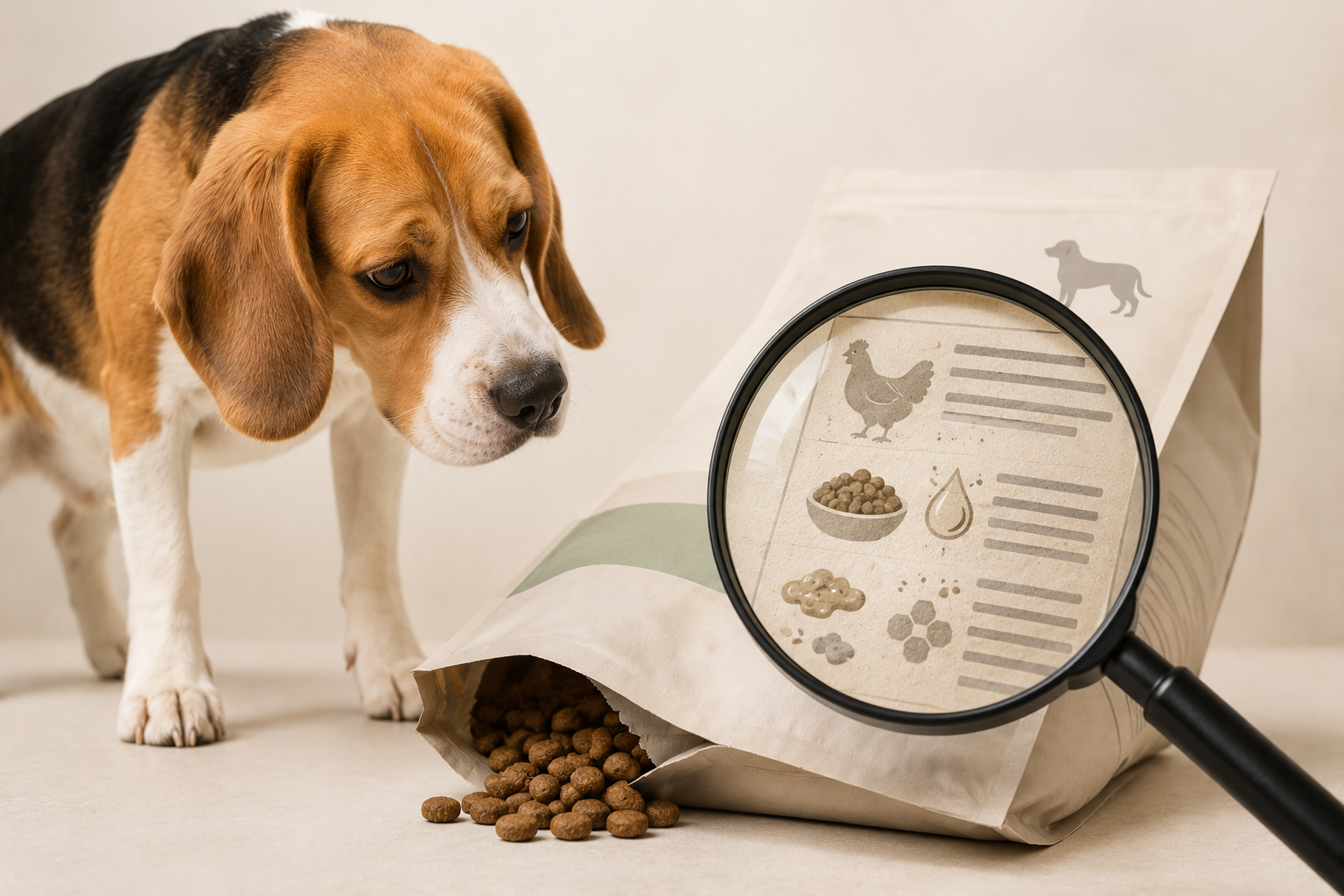
The single most useful skill for an Indian pet parent is reading the back of a pet food bag. Not the front. The front is marketing. The back is the food.
This is a complete walkthrough: what the order of ingredients means, what to look for in the first three, where chicken hides, what the filler words mean, what’s worth ignoring on the front of the bag, and how to compare two real labels side by side.
How to read an ingredient list (the ordering rule)
Pet food ingredients in India, like human food, are listed in descending order by weight before cooking. The first ingredient is the heaviest. The last is the lightest.
There’s a catch. Wet ingredients (fresh meat, broth) are weighed wet, which inflates their position. Once cooked, much of the water is gone. “Chicken” listed first as fresh chicken might end up being a smaller dry-weight contribution than “chicken meal” listed third.
This is why the first three ingredients matter together, not in isolation. A food that lists “chicken, chicken meal, chicken broth, rice…” is a chicken food, full stop. A food that lists “chicken, rice, corn, chicken meal…” is also a chicken food but with substantial filler.
The skill is reading the first three to five together as a unit. They tell you what the food actually is.
First 3
ingredients on the label tell you what the food actually is. The rest is supporting cast.
The first three ingredients: what they should and shouldn’t be
Ideal pattern for a quality protein-led food:
- Ingredient #1: a named meat (chicken, lamb, fish, duck, beef).
- Ingredient #2: a named meat meal of the same protein, OR a quality carbohydrate (brown rice, sweet potato, oats).
- Ingredient #3: a quality carbohydrate or a fat source (chicken fat, fish oil).
Red flags in the first three:
- “Meat” or “meat meal” without a species named.
- “Cereal” or “grains” without species/type named.
- Multiple grain words in close succession (“corn, corn gluten meal, ground corn”), this is “ingredient splitting” to push the protein up the order.
- Sweeteners (sugar, beet pulp, molasses).
For a dog with no allergy issues, this is mostly about value for money, you don’t want to be paying premium prices for filler. For an allergy-sensitive dog, the species naming is critical: anything generic is a hidden variable.
Reading the first three
Look for
- A named meat as ingredient #1 (chicken, lamb, fish, mutton)
- A named meat meal of the same protein at #2 or #3
- Whole carbohydrates: brown rice, sweet potato, oats
- Named fat sources (chicken fat, fish oil)
Avoid
- 'Meat' or 'meat meal' without a species named
- Multiple grain words ('corn, corn gluten meal, ground corn')
- Sweeteners (sugar, beet pulp, molasses)
- Anything starting with a filler grain rather than meat
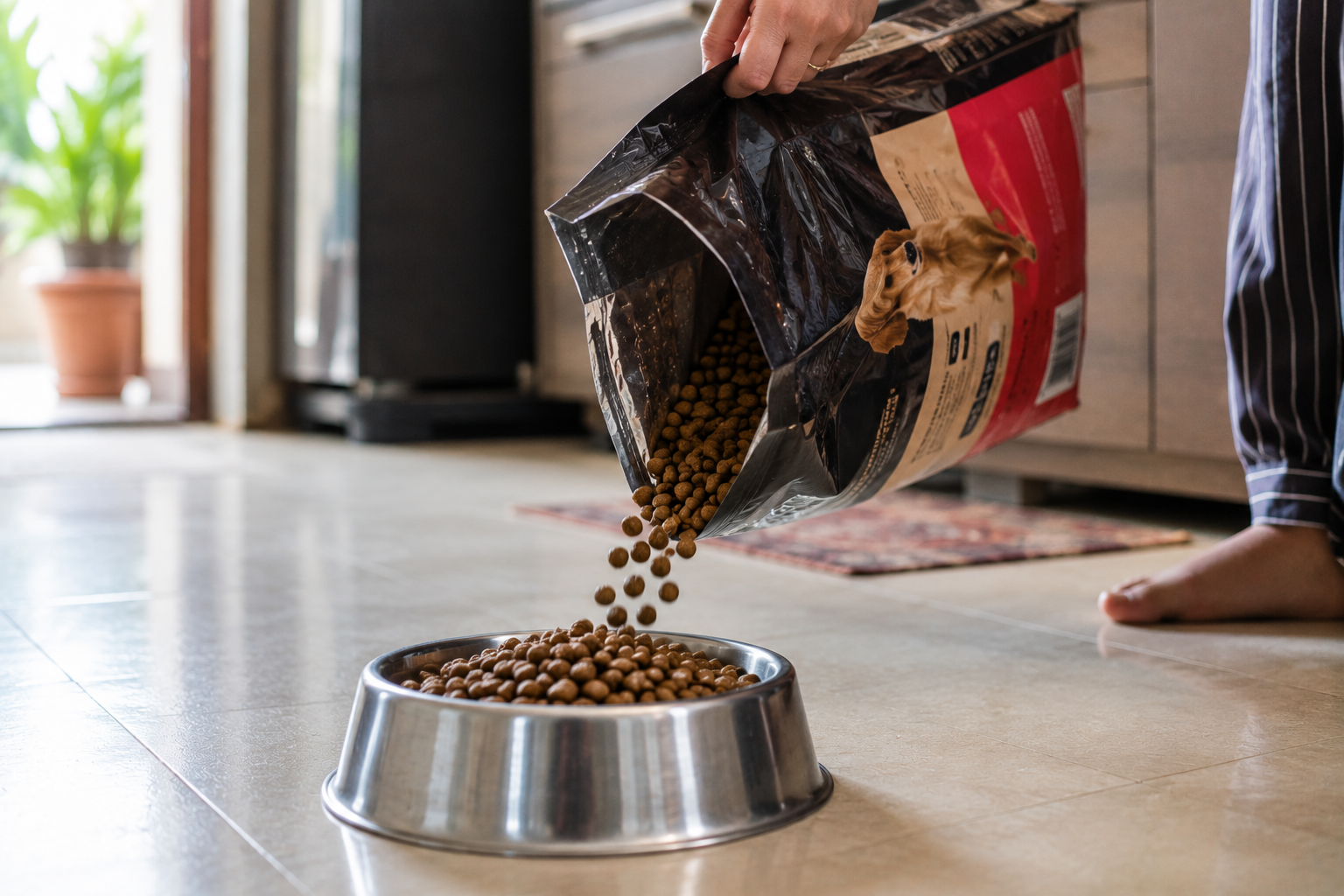
Hidden chicken: the seven words to watch for
This is the most useful single section for anyone running an elimination diet or trying to avoid chicken specifically.
- Chicken: fresh chicken meat. Obvious.
- Chicken meal: dried, ground chicken meat and bone. Counts.
- Chicken by-product / chicken by-product meal: non-meat chicken parts. Counts.
- Poultry / poultry meal / poultry by-product: usually chicken, sometimes turkey or duck. Treat as chicken unless the species is named.
- Meat meal without a species, could include chicken. Treat as suspect.
- Animal fat without a species, could be chicken fat. Treat as suspect.
- Natural flavour / hydrolysed natural flavour: often hydrolysed chicken protein. Treat as suspect.
Read: Hidden chicken, the ingredients that mean chicken without saying chicken
Fillers (corn, wheat, soy) and what they do
Fillers are cheap carbohydrates that bulk up a kibble without contributing meaningful protein quality. These are the most common ones in Indian pet food:
Corn
High carbohydrate, modest protein, often heavily processed. The most common filler in budget kibble.
Corn gluten meal
Concentrated corn protein. Often used to inflate the 'crude protein' number on the label without delivering comparable digestible protein.
Wheat
Common, cheaper than rice. Some dogs are sensitive to wheat, though less commonly than to chicken.
Soy
Concentrated plant protein used to bulk protein numbers cheaply. Some dogs react to soy.
Beet pulp, a sugar industry by-product, also appears frequently as a fibre source. It is generally tolerated but is a marker of lower-quality formulations.
A food where corn or wheat appears multiple times in different forms, “corn, corn meal, ground corn”, is a corn-led food in practice, regardless of where the meat sits on the label.
For an allergy-sensitive dog, fillers themselves are rarely the trigger. Grain allergies are uncommon. The bigger issue is what fillers crowd out.
Preservatives, colours, and the BHA/BHT/ethoxyquin question
Most kibble needs a preservative to keep the fats from going rancid. The choice matters more than most people realise.
Preservatives: what to look for and what to avoid
Look for
- Mixed tocopherols (vitamin E): effective, no known long-term risk
- Rosemary extract: natural antioxidant
- Citric acid / ascorbic acid: vitamin C derivatives
Avoid
- BHA (butylated hydroxyanisole): listed as a possible carcinogen at high doses, still legal in Indian pet food
- BHT (butylated hydroxytoluene): similar profile to BHA
- Ethoxyquin: banned for human food in many countries, still permitted in pet food here
- Propyl gallate: synthetic, less concerning but still unnecessary
For a dog you’re feeding the same food daily for years, the case for choosing naturally preserved food is reasonable on a precautionary basis. None of the synthetic preservatives are proven harmful at the doses found in pet food, but the natural alternative costs no more.
Artificial colours (red 40, yellow 5, blue 2, etc.) serve no nutritional purpose. They are there to make the kibble look like meat. Skip foods that need artificial colour to look good.
What “premium,” “natural,” “holistic,” and “complete & balanced” actually mean
Almost nothing. Here is what each claim actually signals:
Front-of-bag claims, decoded
Premium / super-premium
No regulated definition in India. Any brand can print this on any bag.
Natural
No regulated definition. A food can be 'natural' and still contain BHA, BHT, and synthetic colours.
Holistic
No regulated definition anywhere. Pure marketing.
Complete and balanced
This one has meaning: it meets FSSAI nutritional adequacy standards for the stated life stage. A baseline, not a quality marker.
Vet-approved
Typically means a vet was paid to consult on the formulation. Not an independent endorsement from the veterinary community.
Made with real chicken
Says nothing about how much chicken, which part, or whether it leads the ingredient list.
The label that matters is the back of the bag. The front is wallpaper.
A side-by-side: how to actually compare
Pick two dog food bags from your nearest supermarket or pet store and work through these three checks on each.
- 1
Read the first five ingredients
What is the leading meat? Is the species named? How many of the first five are filler grains or unnamed meat?
- 2
Scan the full ingredient list
Check for hidden chicken (the seven words above), synthetic preservatives (BHA, BHT, ethoxyquin), artificial colours, and sweeteners.
- 3
Read the guaranteed analysis
Crude protein above 22% is a reasonable floor (28%+ indicates a meat-led recipe). Fat 12-18%, fibre under 5%, moisture 10-12% for dry kibble.
This isn’t to crown one food a winner. It’s to show you what the food actually is, beneath the bag’s design. Most pet parents are surprised by the gap between the front and the back.
The honest summary
A food is doing its job if:
- The first ingredient is a named meat.
- The first three or four ingredients aren’t dominated by filler.
- There’s no hidden chicken if you’re avoiding chicken.
- The preservative is natural.
- There’s no artificial colour.
You don’t need to buy the most expensive bag in the store. You need to buy a bag whose label tells you what’s in it.
Take the 2-minute Allergy Check, the questions cover food along with everything else.
The label is the food. The bag is marketing.
This is one of the most useful five-minute skills you can build as a pet parent. Once you’ve read three or four labels properly, you stop being persuaded by the front of the bag, and you spend much less time in the pet food aisle.
This article is education, not diagnosis. If symptoms persist or worsen, please see your vet.
Frequently asked
What does 'meat by-product' actually mean? +
Non-meat parts of an animal, organs, blood, bone, intestines, sometimes feet and beaks. By-products aren't inherently bad (organ meat is nutritionally rich) but the term hides what species is in the food. For an allergy-sensitive dog, anything that doesn't name a species is a question mark.
Are FSSAI standards enough for pet food? +
FSSAI regulates pet food in India but the standards are less strict than human food regulation, and ingredient declarations are not enforced as tightly as in some other countries. The label is still your best tool, but it isn't a guarantee. Brands that voluntarily disclose more usually do so because they have something to disclose.
Is grain-free dog food healthier? +
Not inherently. Grain itself is rarely the cause of dog food allergies. The grain-free trend has even been associated with cardiac issues in some breeds when grain is replaced with high levels of legumes. The real questions are: which protein, what's the protein quality, and are there fillers padding the ingredient list.
What's the difference between 'chicken' and 'chicken meal'? +
'Chicken' is fresh chicken meat, weighed wet. 'Chicken meal' is chicken meat and bone that has been dried and ground, concentrated, with most of the water removed. Both contain chicken. For an elimination diet, both count as chicken.
Should I be worried about preservatives like BHA and BHT? +
BHA, BHT, and ethoxyquin are synthetic preservatives that are still legal in pet food in India and several other countries. The evidence for harm is mixed but the precautionary case for choosing food preserved with mixed tocopherols (vitamin E) and rosemary extract instead is reasonable, especially for a dog you're feeding daily for years.
Niko's story is what started ode. Read it →
Related reading

Hidden chicken: the ingredients that mean chicken without saying chicken
Natural flavour, animal fat, meat meal, poultry by-product: the label words that hide chicken in Indian pet food, treats, and prescription diets.
8 min read
Novel proteins in India: what to actually feed an allergic pet
Novel protein options for allergic dogs and cats in India: fish, mutton, rabbit, why duck isn't a real option here, sourcing, prep, and the 8-week trial rule.
9 min read
Chicken allergy in dogs: signs, why it's everywhere in India, and what to try
Symptoms of chicken allergy in dogs, why chicken dominates Indian pet food, what 'grain-free' really means, and the 6–8 week elimination check.
9 min read